
Once a small fortified outpost on Venice’s mainland frontier, Mestre evolved from a medieval castle town into a modern urban center that now houses two-thirds of Venice’s municipal population.
At a glance
Mestre originated as a river settlement named after the Mestria (or Mestre) river, which flowed into the Venetian lagoon. The earliest official document mentioning the place dates to 994, when Holy Roman Emperor Otto III granted lands here to Rambaldo, Count of Collalto. Medieval Mestre served as a strategic buffer between the Holy Roman Empire and the Venetian Republic, commanding trade routes and protected by two successive fortresses: the Castelvecchio and later the Castelnuovo. After Venice conquered the territory in 1337, Mestre became integral to the Stato da Terra. The town earned the honorific title Mestre Fidelissima for its heroic resistance during the 1509–1513 War of the League of Cambrai.
History
The earliest probable reference appears in a 710 document mentioning “Mestrina near the mountains,” though its exact identification remains uncertain. The first confirmed record is Otto III’s 994 donation deed, which granted forest and agricultural lands to Count Rambaldo—a document now preserved in the Czech Republic after Bohemian soldiers removed it from Susegana Castle during World War I.
By 1152, Mestre was established as a significant settlement with a port, castle, and archpriest church of San Lorenzo. For over a century, control shifted between local bishops and the Treviso commune until Ezzelino III da Romano’s incursions in the 1230s forced a reorganization under Treviso’s civil administration. When the Scaligeri lordship of Verona threatened Venetian interests in the early 14th century, Venice acted decisively. On 29 September 1337, Venetian commander Andrea Morosini captured the castle through negotiation rather than force.
Under Venetian rule, Mestre developed rapidly as a commercial crossroads. The construction of the Canal Salso—an artificial waterway connecting the village to the lagoon—transformed it into a trade hub. A new fortress, the Castelnuovo, was built to replace the aging Castelvecchio. By the 15th century, administrative structures matured; the city council established itself in 1459 in the Provvederia.
The War of the League of Cambrai (1509–1513) tested Mestre’s loyalty. After the Venetian defeat at Agnadello, Mestre’s garrison under Niccolò da Pitigliano became Venice’s last mainland stronghold, staging rescue expeditions for besieged Treviso. Despite Spanish and German assaults that sacked and burned the inhabited center, the town’s stubborn resistance earned it the perpetual title Mestre Fidelissima.
Mestre’s fortunes changed dramatically under foreign rule. Napoleon’s occupation (May 1797) ended Venetian governance. The 1797 Treaty of Campoformio transferred the territory to Austria. From 1806 to 1814, under French administration, Mestre became a “Municipality” within the Department of Tagliamento, absorbing neighboring municipalities. After Napoleon’s fall, it returned to Habsburg control as part of the Lombard-Veneto Kingdom.
The Risorgimento of 1848 saw Mestre’s citizens play an active role. The Civic Guard, reinforced by volunteers, captured Forte Marghera and defended it against Austrian reoccupation, but the revolt was ultimately suppressed by June 1849. Mestre was annexed to the Kingdom of Italy in 1866 after Italian troops captured Forte Marghera; Giuseppe Garibaldi visited the city on 6 March 1867, speaking from Piazza Maggiore.
Modern Mestre emerged in the 20th century. The opening of the Milan-Venice railway in 1842 shifted the town’s center. In 1917, a quarter of Mestre’s territory became the industrial zone of Marghera (Bottenigo). By Royal Decree in August 1926, Mestre—then 31,000 inhabitants—was formally incorporated into Venice along with Chirignago, Zelarino, and Favaro Veneto, a consolidation driven by the creation of Porto Marghera industrial complex under industrialist Giuseppe Volpi and Count Vittorio Cini.
The Liberty Bridge (Ponte della Libertà, originally Ponte Littorio) opened on 25 April 1933, connecting Mestre directly to Venice and spurring urban expansion. During World War II, the heaviest bombardment occurred on 28 March 1944, destroying over a thousand houses and killing 164 people. Post-war Mestre experienced explosive growth, swelling from 20,000 to 200,000 inhabitants by the 1970s—rapid development without master planning that altered its urban character. The San Giuliano overpass, completed in 1955, further integrated Mestre into the greater Venetian metropolitan area. Today, Mestre’s 180,000+ residents constitute over 66 percent of Venice’s municipal population.
What you see
Little remains of medieval Mestre’s defensive structures. The Castelvecchio, the original fortress, was largely demolished in the 15th century as power shifted to the newer Castelnuovo. The Clock Tower and twin Belfredo Tower—the castle’s last vestiges—survived into the modern era; the Belfredo was demolished in 1876. Today, its footprint is traced in the pavement of Via Torre Belfredo, adjacent to the Giardini delle Mura, where fragments of fortification walls and a smaller tower foundation remain visible.
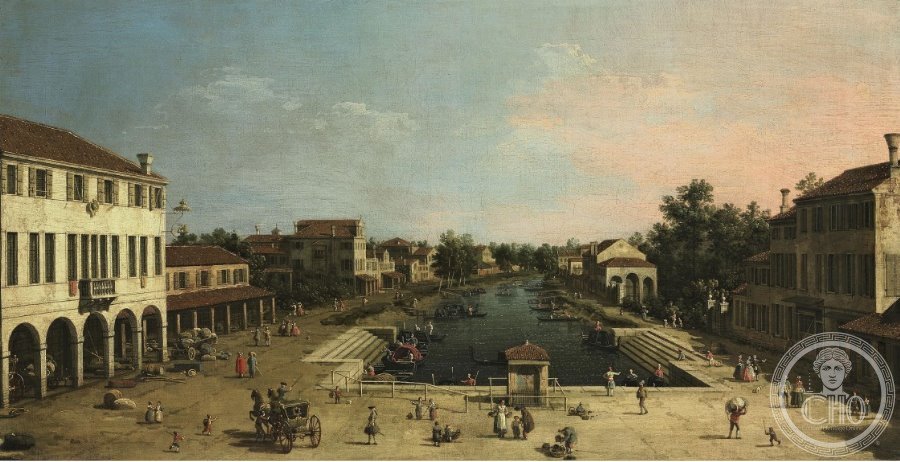
Historic squares and waterways shaped Mestre’s urban identity. Piazza Barche (now Piazza Ventisette Ottobre), depicted in Canaletto’s paintings, once fronted the drained Canal Salso—a vital trade artery that is now underground. The Canal Salso flowed from the lagoon through the heart of the village, anchoring Mestre’s economic life until the late medieval deviation of the Marzenego river rendered it less practical.
Monuments to civic pride punctuate the urban fabric. A commemorative column honoring those who died in the 1848–1849 resistance was inaugurated in Piazza Barche on 4 April 1886. Plaques mark Garibaldi’s 1867 visit from a Piazza Maggiore balcony and commemorate the sortie of Forte Marghera.
Modern Mestre reflects rapid 20th-century growth. The Ponte della Libertà (1933) and Corso del Popolo symbolize connection to Venice. Urban intensification, however, left few green spaces; by 1980 the city recorded a national low of 20 square centimeters of green per inhabitant. Many historic canals were drained, buried, or diverted; even the distinctive Marzenego tombstone in Via Alessandro Poerio was overshadowed by the Cel-Ana building.
Cultural significance
Mestre’s name itself carries etymological weight. Rather than deriving from legendary Trojan origins (as some 19th-century scholars proposed through the mythical hero Antenore), the most credible hypothesis traces it to the Mestria or Mestre river on whose banks the settlement arose. This riverine origin—shared with nearby Musestre—points to practical medieval geography rather than heroic genealogy.
Politically, Mestre exemplifies Venice’s expansion onto the mainland. The 1337 conquest initiated the Stato da Terra—the territorial dominion that made Venice a major power beyond the lagoon. Medieval and Renaissance Mestre guarded crucial trade corridors and military approaches, making it a flashpoint in conflicts between emperors, lordships, and the Serenissima.
The town’s award of Fidelissima status reflects its role in Venetian identity. Despite occupation by Spanish and German forces in 1513, its residents’ resistance earned them a lasting honorific. This pride resurfaces throughout history: in 1848–1849, Mestre’s Civic Guard and volunteers rallied to defend Forte Marghera during the Risorgimento; commemorative plaques and monuments preserve that memory.
In modern times, Mestre represents both urban success and the costs of rapid industrialization. Its transformation from a 20,000-person town to a 200,000-person metropolitan center in the 1950s–1970s embodies Italy’s post-war economic expansion, anchored by the chemical and port industries of Porto Marghera. That same growth also destroyed much of its historical fabric and environmental character, making Mestre a contested symbol in debates over Venice’s future—a reality underscored by four municipal separation referendums between 1979 and 2003, all ultimately rejected.
Key facts
- Address: Via Torre Belfredo, Mestre, Venice, Veneto
- Coordinates: 45.4673349, 12.2355581
- Earliest documented mention: 994 (Otto III’s donation deed)
- Official website: www.comune.venezia.it
- Phone: 041 2748111
Practical information
Mestre is fully integrated into the municipality of Venice and accessible via the Ponte della Libertà. The area contains no major monuments requiring separate visitor hours, as most medieval structures have been demolished or are fragmentary. The Giardini delle Mura provides access to remains of the Castelvecchio fortifications. For detailed information on cultural sites and local services, contact the municipality of Venice.
Getting there
Mestre lies on the Venetian mainland, approximately 2 kilometers northwest of Venice’s historical center. You can reach it by road via the Ponte della Libertà (opened 1933) or by train—the railway station serves as a major hub connecting Venice, Padua, and northern Italy. Public buses and vaporetto services link Mestre to Venice; consult the municipality website for current schedules.
See the place
Sources & resources
Find it on the map
See this place and what’s around it →Historical events at this place (2)
📷 Become a Cultural Heritage Online photographer
Share your photos of places: they stay published under your name as the author. The more they're seen, the more you get noticed — and soon a contest will reward the most appreciated photos.
Log in or sign up free to add a photo