
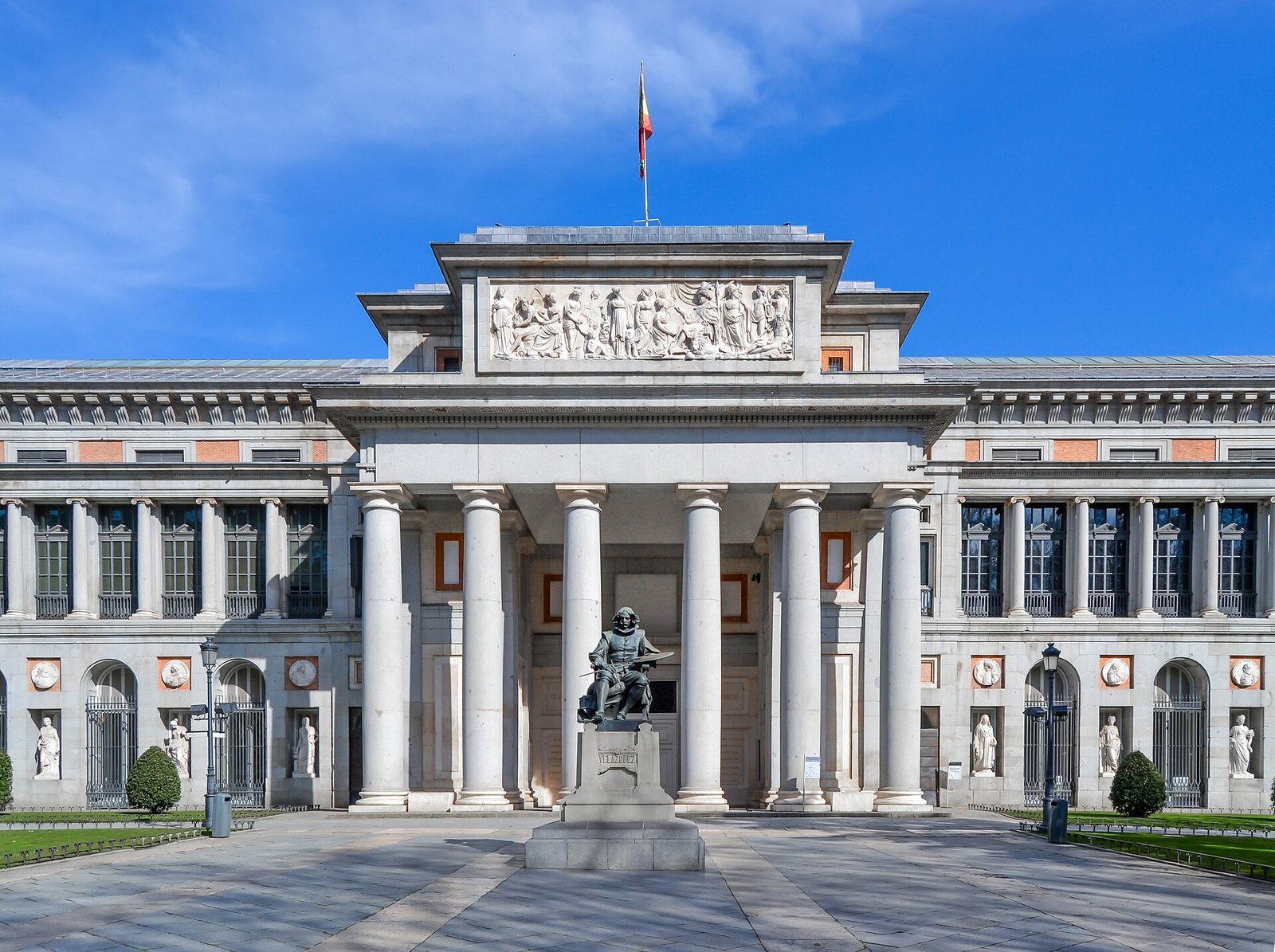
The Museo Nacional del Prado is Spain’s principal national art museum and one of the great encyclopaedic collections of European painting in the world. Founded in 1819 on the Paseo del Prado in central Madrid, the museum holds more than 20,000 works spanning the twelfth to the early twentieth century, with particular depth in Spanish masters — Velázquez, Goya, and El Greco — as well as outstanding holdings of Flemish, Italian, and other European schools assembled by the Spanish crown over five centuries of royal collecting.
At a glance
- Type
- National art museum
- Period
- Building designed 1785; museum opened 1819
- Style
- Spanish Neoclassicism (Juan de Villanueva, architect)
- Location
- Paseo del Prado, Madrid, Spain
- Coordinates
- 40.4138° N, 3.6943° W
Overview
The Prado houses collections of European art from the twelfth century to the early twentieth century, built on the former Spanish royal collection and representing the single finest assemblage of Spanish painting in existence. The numerous works by Francisco Goya make him the most extensively represented artist in the collection, followed by major holdings from Hieronymus Bosch, El Greco, Peter Paul Rubens, Titian, and Diego Velázquez. Velázquez himself was instrumental in bringing Italian masterworks to the Spanish court, and those acquisitions now form one of the largest collections of Italian Renaissance painting outside Italy.
History
The Prado building was designed by Juan de Villanueva in 1785 on the orders of King Charles III, originally intended as a natural history museum. After the Napoleonic Wars, Ferdinand VII and Queen Isabella of Braganza repurposed the structure to display the royal art collection, and the museum opened to the public on 19 November 1819. During the Spanish Civil War, the collection was evacuated to Geneva for safekeeping and returned in 1939. A major expansion designed by Rafael Moneo was completed in 2007, adding the Cloister of Los Jerónimos and the Villanueva building’s underground connection.
What you see
The main Villanueva building presents a long, austere Neoclassical facade articulated by Doric pilasters and punctuated by three principal entrances — the Puerta de Goya, Puerta de Velázquez, and Puerta de Murillo. Inside, the galleries are arranged thematically and chronologically across three floors, with Velázquez’s Las Meninas (1656) and Goya’s Saturn Devouring His Son (c. 1820–23) among the most visited works. The museum also holds Bosch’s The Garden of Earthly Delights triptych, one of the most studied paintings in Western art history.
Cultural significance
The Prado is consistently ranked among the top five art museums in the world and is the centrepiece of Madrid’s “Golden Triangle of Art,” alongside the Museo Reina Sofía and the Museo Thyssen-Bornemisza. Its collection is foundational to the study of Spanish and European art history, and it remains an active research institution with conservation labs, a specialist library, and international loan programmes that reach audiences worldwide.
Practical information
- Address
- Paseo del Prado, s/n, 28014 Madrid, Spain
- Opening hours
- Monday–Saturday 10:00–20:00; Sunday and public holidays 10:00–19:00 (check official website for current hours)
- Admission
- General admission charged; free entry Monday–Saturday 18:00–20:00 and Sunday 17:00–19:00 — check museodelprado.es for current prices
- Website
- museodelprado.es
Getting there
The nearest metro station is Banco de España (line 2) or Atocha (line 1), both a short walk from the museum entrances on the Paseo del Prado. Bus lines 1, 2, 5, 9, 10, 14, 15, 20, 51, 52, 53, 146, and 150 stop along the Paseo. Bicycle parking is available on the adjacent streets.
Sources & resources
Find it on the map
See this place and what’s around it →📷 Become a Cultural Heritage Online photographer
Share your photos of places: they stay published under your name as the author. The more they're seen, the more you get noticed — and soon a contest will reward the most appreciated photos.
Log in or sign up free to add a photo