
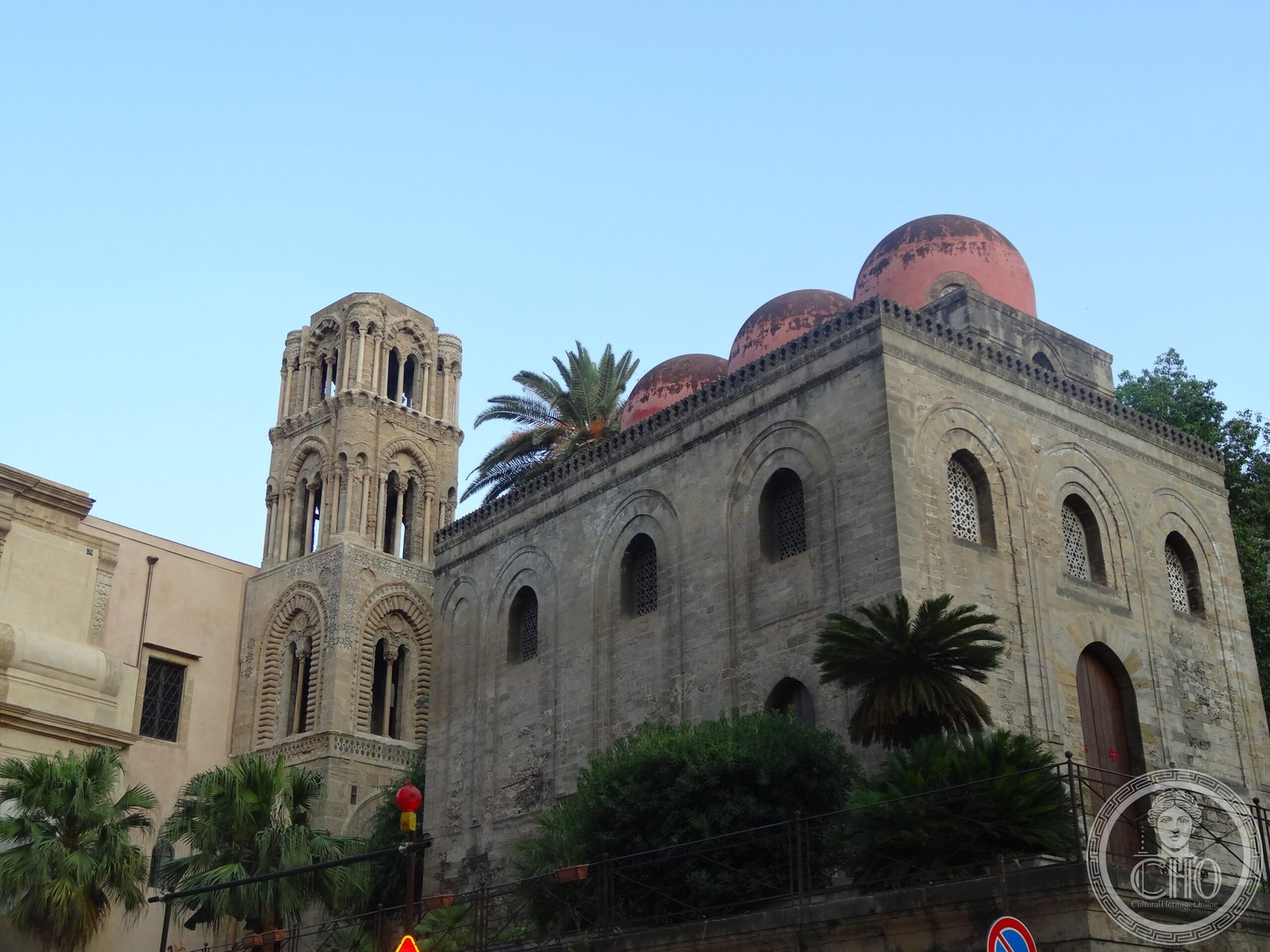
Church of San Cataldo
The Church of San Cataldo is a twelfth-century Catholic church on Piazza Bellini in central Palermo, Sicily, erected in 1154 as one of the finest surviving examples of Arab-Norman architecture. Its three compact red domes, blind arcading of interlaced arches, and crenellated roofline create an exterior of austere perfection, while the bare stone interior — stripped of later additions — conveys the geometry of Norman-Islamic spatial thinking with unmediated clarity. Since the 1930s the church has belonged to the Order of the Holy Sepulchre.
At a glance
- Type
- Catholic church; former conventual church
- Period
- Built 1154 under Norman rule
- Style
- Arab-Norman (Sicilian Romanesque with Islamic architectural elements)
- Location
- Piazza Bellini, Palermo, Sicily, Italy
- Coordinates
- 38.1148° N, 13.3625° E
- Current custodian
- Order of the Holy Sepulchre (since the 1930s)
Overview
San Cataldo stands on Piazza Bellini alongside its larger neighbour Santa Maria dellAmmiraglio (the Martorana), the two buildings together forming the centrepiece of one of Palermos most visited historic squares. Erected in 1154 during the reign of William I of Sicily, it was commissioned by Maio of Bari, the kings chief minister, and dedicated to the Irish bishop Saint Cathal of Taranto. The church is inscribed as part of the UNESCO World Heritage Site “Arab-Norman Palermo” (2015) and is among the best-preserved twelfth-century buildings on the island.
History
San Cataldo was founded by Maio of Bari, Chancellor of Sicily under William I, around 1154, and dedicated to Saint Cathal (San Cataldo), whose relics were venerated in southern Italy. After the Norman period the church passed through various phases of ownership and use, serving at times as a post office before being restored to religious use. Since the 1930s it has been administered by the Order of the Holy Sepulchre of Jerusalem, who maintain it as a functioning chapel. Unlike many Sicilian Norman buildings, San Cataldo was not substantially altered in later centuries, preserving the twelfth-century fabric with relatively little modification.
What you see
The exterior presents three hemispherical domes on a square base, surrounded by blind arcading of interlaced pointed arches and a crenellated roofline — a vocabulary combining Norman, Islamic, and Byzantine motifs in the synthesis that defines the Arab-Norman style. The interior is a three-aisled basilica plan in bare pale stone, unadorned except for the geometric floor mosaic that survives from the Norman period and the carved stone capitals of the arcade columns. Slender pointed arches divide the nave from the side aisles, and light enters through small windows in the domes, casting a diffuse, meditative illumination over the stone surfaces.
Cultural significance
San Cataldo is inscribed within the UNESCO Arab-Norman Palermo World Heritage Site (2015), which recognises the exceptional cultural synthesis achieved under Norman rule in twelfth-century Sicily. Together with the Martorana immediately adjacent, it anchors Piazza Bellini as an outdoor museum of medieval sacred architecture where Islamic, Byzantine, and Romanesque traditions coexist within a few metres of each other — an arrangement unique in Europe.
Practical information
- Address
- Piazza Bellini 3, 90133 Palermo PA, Italy
- Hours
- Monday–Friday 09:30–13:30, 15:00–17:30; weekends vary — check official website
- Admission
- Small admission fee; check Order of the Holy Sepulchre website for current prices
Getting there
Piazza Bellini is in the pedestrianised heart of Palermos historic centre, a five-minute walk from the Quattro Canti at the intersection of Via Maqueda and Corso Vittorio Emanuele. Bus lines 101, 102, and 107 stop on Corso Vittorio Emanuele within a few minutes walk. Palermo Centrale station is approximately 15 minutes on foot; Palermo Falcone–Borsellino Airport is connected by bus or train to the city centre.
Sources & resources
Find it on the map
See this place and what’s around it →📷 Diventa un fotografo di Cultural Heritage Online
Condividi le tue foto dei luoghi: restano pubblicate con la tua firma come autore. Più vengono viste, più ti fai conoscere — e presto un concorso premierà le foto più apprezzate.
Accedi o registrati gratis per aggiungere una fotoDo you manage this place?
This page is read by travellers and heritage enthusiasts who find it on Google. Keep it accurate — and make it work for you. Free for non-profit heritage institutions.