
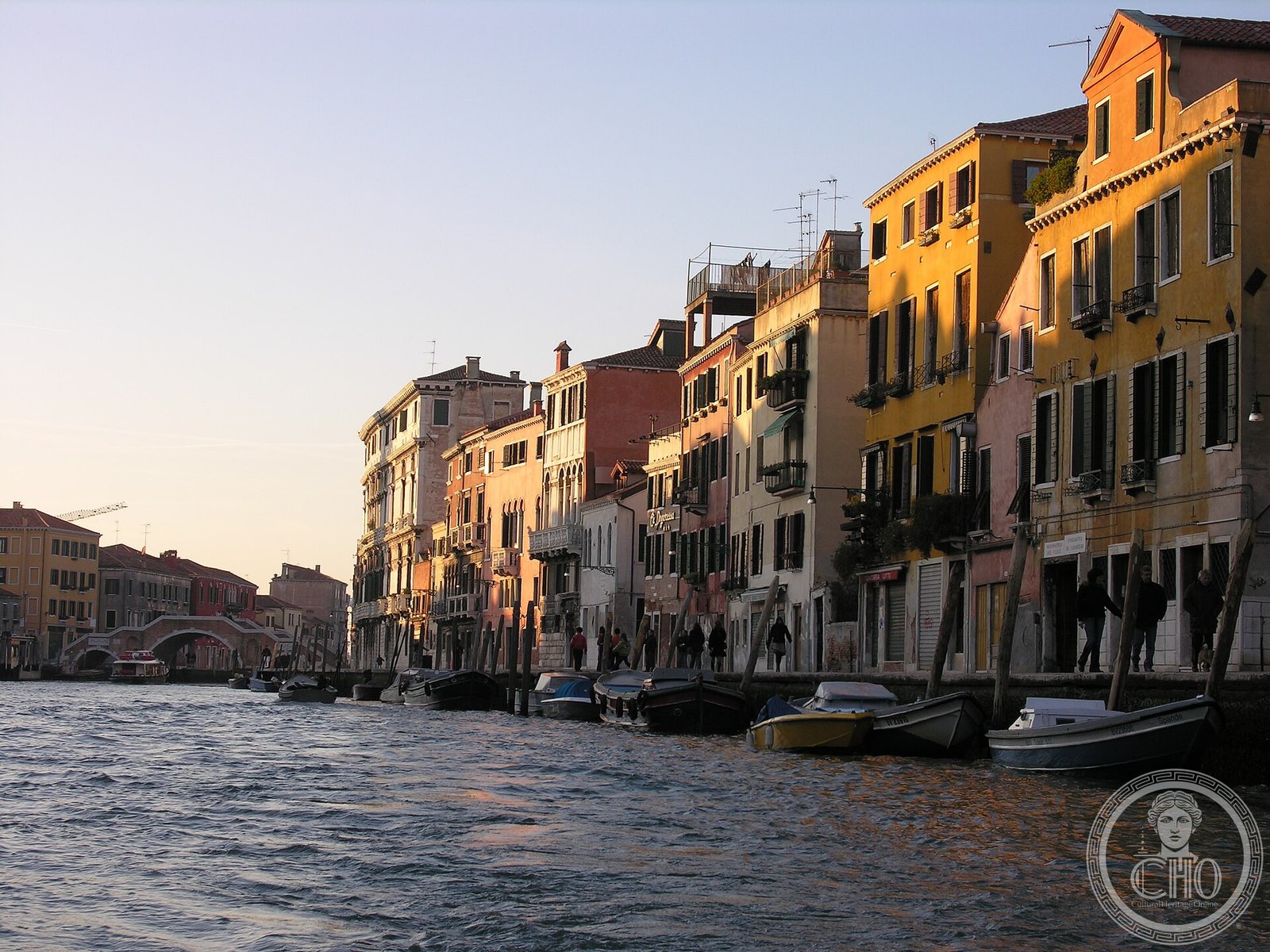
One of Venice’s most vital waterways, the Cannaregio Canal connects the Grand Canal northwestward through the heart of the Cannaregio district, passing alongside Renaissance palaces and lined with two of the city’s most distinctive bridges.
At a glance
The Cannaregio Canal stretches nearly 800 metres between the foundations of San Giobbe and Sacca San Girolamo. Its width varies from 22 metres at the Ponte delle Guglie to 27 metres near Ca’ Foscari University’s campus. Two remarkable bridges span the waterway: the 16th-century Guglie bridge, uniquely adorned with pinnacles, and the Three Arches bridge—Venice’s sole surviving multi-arched bridge.
History
The Cannaregio Canal developed as a fundamental artery connecting Venice’s northern districts to the commercial heart of the Grand Canal. The Guglie bridge dates to the 16th century, reflecting the waterway’s importance during the Republic’s later centuries. The canal’s two banks gradually attracted patrician families, whose building projects transformed the shoreline into a gallery of Venetian palace architecture.
What you see
Along the canal’s fondamenta (embankments) stand numerous palaces of architectural merit. Palazzo Labia dominates at the intersection with the Grand Canal, while Palazzo Priuli Venier Manfrin, Palazzo Savorgnan, Palazzo Bonfadini Vivante, Palazzo Testa, and Palazzo Surian Bellotto line the waterway with their richly detailed facades. Three churches overlook the canal: Santa Maria dei Penitenti with its convent complex, San Giobbe, and San Geremia. A statue of San Giovanni Nepomuceno, sculpted by Morlaiter, stands on the western bank at the canal’s entrance to the Grand Canal.
Cultural significance
The Cannaregio Canal represents the scale and ambition of Venetian urban planning beyond the Grand Canal itself. Its architecture spans centuries of the city’s development, from Renaissance palace design to sacred spaces serving the district’s population. The two bridges stand as engineering achievements and symbols of Venetian craftsmanship, with the Three Arches bridge representing a vanishing typology in the lagoon.
Key facts
- Length: approximately 800 metres
- Width: 22–27 metres
- Address: Fondamenta Cannaregio, 276, 30121 Venezia
- Coordinates: 45.4447688, 12.3231179
- Official website: http://events.veneziaunica.it/it/content/rio-di-cannaregio
- Phone: 041 24 24
Practical information
The canal is freely accessible as a public waterway and pedestrian route. Water taxis and vaporetto services operate along Venice’s main canals; local transit information is available through official Venezia Unica services.
Getting there
The Cannaregio Canal is easily reached from Venice’s Piazzale Roma or Santa Lucia railway station, both on the city’s western edge. The canal runs through the Cannaregio sestiere (district), one of Venice’s most residential and least touristy neighbourhoods. You can walk the full length along the fondamenta or travel by vaporetto (public water bus).
See the place
Sources & resources
- Venezia Unica: http://events.veneziaunica.it/it/content/rio-di-cannaregio
- Cultural Heritage Online: https://culturalheritageonline.com
Find it on the map
See this place and what’s around it →
Historical events at this place (1)
📷 Become a Cultural Heritage Online photographer
Share your photos of places: they stay published under your name as the author. The more they're seen, the more you get noticed — and soon a contest will reward the most appreciated photos.
Log in or sign up free to add a photo