

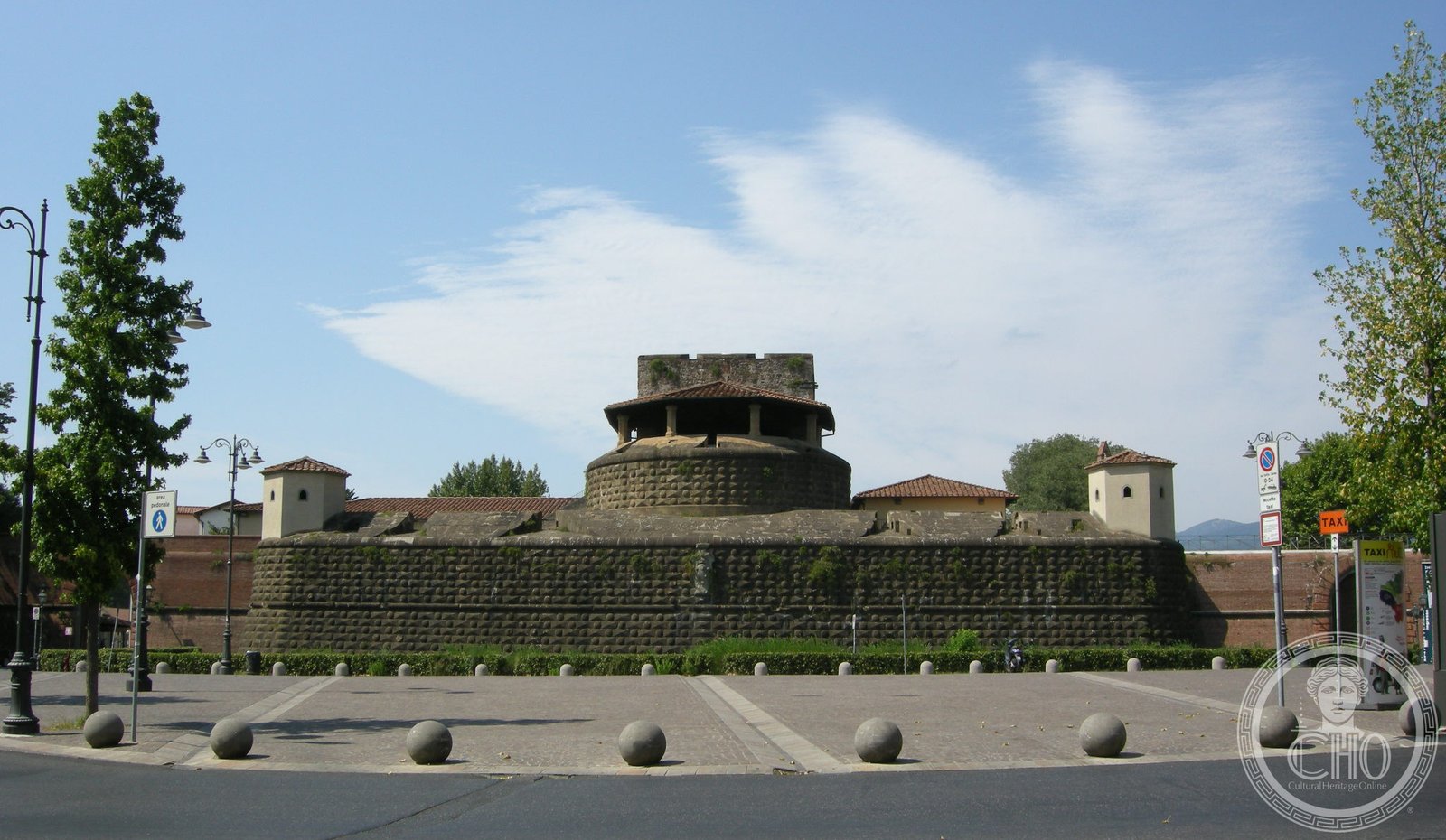
A pentagonal military stronghold built in the 1530s to consolidate Medici power over Florence, now serving as a major exhibition and conference venue.
At a glance
This fortress stands within Florence’s defensive perimeter, surrounded by ring-road boulevards and part of the Firenze Fiera exhibition complex. Today it hosts national and international conferences, concerts, and cultural events rather than troops.
History
Begun in May 1533 under the supervision of Alessandro Vitelli and Pier Francesco da Viterbo, the fortress was constructed by da Viterbo and Antonio da Sangallo the Younger between 1534 and 1537 on orders from Alessandro de’ Medici. The first stone was laid on 15 July 1534; by December that year, the fortification was largely complete.
The structure served multiple purposes: controlling the city after the Medici’s return from the Siege of Florence, accommodating troops, and providing refuge for rulers during potential revolts. Its massive form deliberately intimidated the Florentine population. The side facing the city received monumental treatment from Sangallo to amplify this effect.
During the Lorraine period, additional buildings of architectural interest were constructed, including officers’ quarters and a theater. When Florence’s fourteenth-century walls were demolished during the capital period, the fortress remained; its moats were subsequently leveled and most walls buried.
The military maintained control until 1967. Restoration and adaptation work for Firenze Fiera began in recent decades, exposing archaeological features and requiring demolition of barracks-era structures.
What you see
The fortress displays a regular pentagonal plan with substantial moats and covered passages—features that impressed even the marquis de Sade, who visited in 1775 and noted its arsenal and cannon foundry. Restoration work has revealed the fourteenth-century Porta a Faenza and traces of the Mugnone stream, which once fed the defensive moats.
Visitors can explore the keep and powder magazine. Two modern exhibition pavilions—the Spadolini (1977) and Cavaniglia (1996)—were added to accommodate Firenze Fiera events. The Palazzo dei Congressi occupies the gardens of the adjoining Villa Contini Bonacossi.
Cultural significance
The fortress exemplifies Renaissance military engineering and Medici political strategy. Though rarely used militarily, it remains a testament to early modern defensive architecture and dynastic power consolidation. Today it bridges history and contemporary civic life, hosting cultural events within its historic walls.
Key facts
- Address: Viale Filippo Strozzi, 1, 50129 Florence
- Coordinates: 43.7804009, 11.2496664
- Designed by: Pier Francesco da Viterbo and Antonio da Sangallo the Younger
- Built: 1534–1537
- Phone: 055 49721
- Website: http://www.firenzefiera.it/le-nostre-strutture/fortezza-da-basso/
Practical information
The Fortress functions as an exhibition and events space under Firenze Fiera management. Opening hours and access depend on scheduled events and conferences. The Opificio delle Pietre Dure maintains restoration laboratories within the complex. Contact via the official website or phone number for current programming and visiting details.
Getting there
The fortress is located at Viale Filippo Strozzi in central Florence, accessible by public transport and accessible from the city center via the ring-road boulevards that now surround it.
Sources & resources
Find it on the map
See this place and what’s around it →Historical events at this place (6)
- 2024 SAR - Salone dell'Arte e del Restauro di Firenze - nona edizione 2024
- 2024 MIDA - Mostra Internazionale dell'Artigianato di Firenze ed. 2024
- 2025 Alla designer Patricia Urquiola va il Premio Internazionale “Leonardo da Vinci” alla Carriera
- 2025 Annunciate le NEW ENTRIES tra i Guests of Honour e i Progetti Speciali della Florence Biennale
- 2025 Patricia Urquiola presenta la mostra TRANSITIONS per la Florence Biennale
- 2025 Tim Burton protagonista alla Florence Biennale con l’inedita mostra personale “Tim Burton: Light and Darkness”
📷 Become a Cultural Heritage Online photographer
Share your photos of places: they stay published under your name as the author. The more they're seen, the more you get noticed — and soon a contest will reward the most appreciated photos.
Log in or sign up free to add a photo